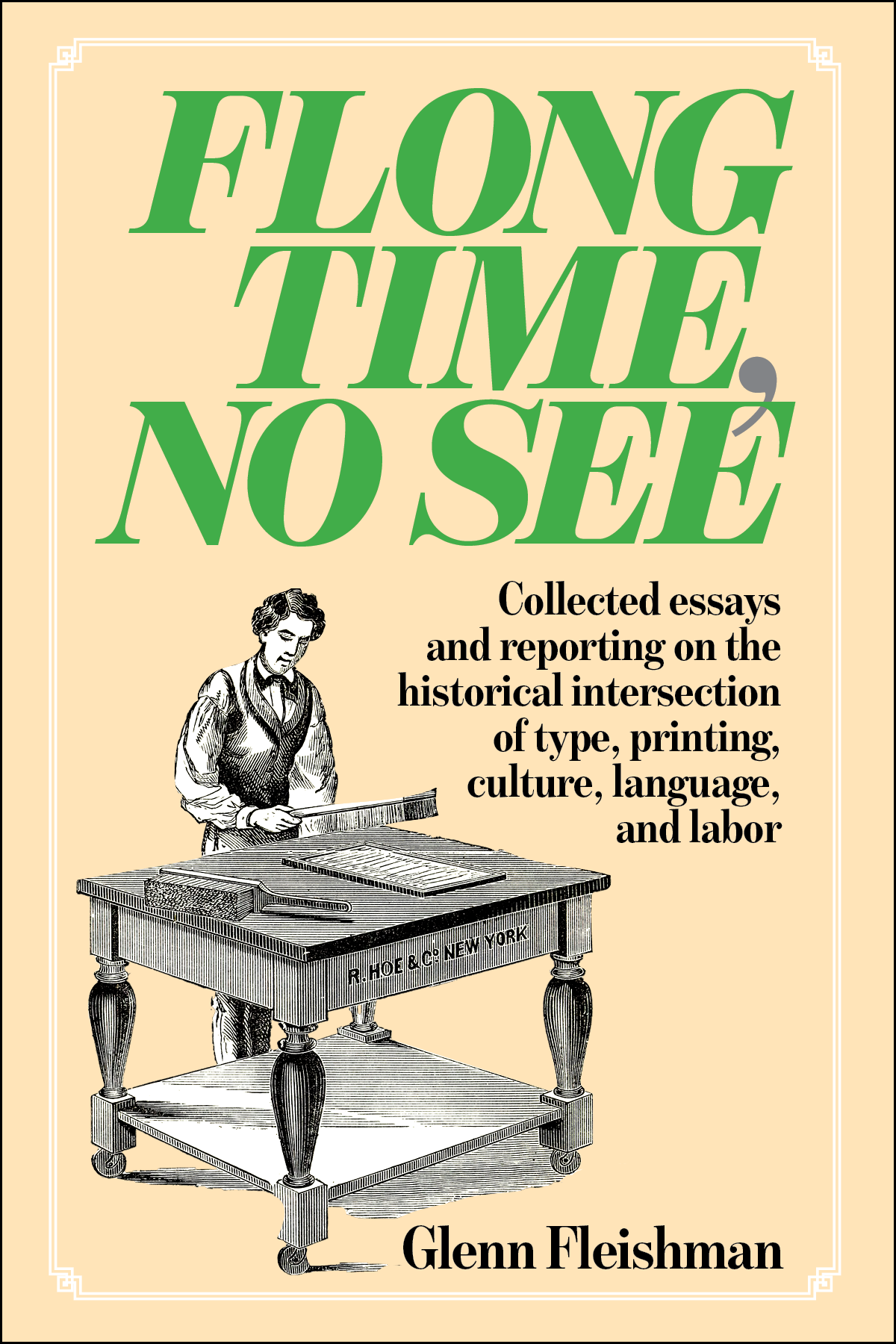
Flong Time, No See
Softcover Book
Why did typesetters get paid to compose metal type and then throw it away? How did one New York Times printer stay employed for over 50 years on a "job for life"? What — what I ask you! — does flong mean?!
Details
The answer to these, and many other questions you never knew you had about the history of printing, will be found in Flong Time, No See. This book brings together work I've researched and published over the last seven years, which I will revise and expand for this publication. These are stories about how we made and shared the written word — and what we lost along the way.
The print edition will be a 352-page paperback in a 6×9–inch (15×23 cm) format with a full-color cover and a black-and-white interior.
The stories included are:
- The Flong Goodbye: The history of a forgotten material that allowed the evolution of printing, the growth of newspapers, and syndication. Even the name is fun.
- The Typewriter Is Not a Typesetter: A 1919 wildcat typesetting strike led some magazines to conclude that typewriters had finally reached the quality necessary to produce type for printing. They were wrong.
- Eradicate the Type Lice: Printers played nasty tricks on apprentices, and only some felt guilty about it later. It was part of a mild hazing process that lasted seemingly for centuries.
- Bogus! Typesetters were paid to set copy that was thrown away to avoid intrusion on their monopoly. Even the Supreme Court got involved — and said it was legitimate!
- Lorem Ipsum Is Garbled: The most reproduced and misunderstood text of the last 40 years doesn't mean anything. How did it get that way?
- Reading the Reprintings: Books hide information about revisions through markings that can obscure the authoritative version of an author's text or a non-fiction work.
- The Truth Is in the Stars: Newspapers used to publish as many as 10 different editions every day. Learn to read the historic and modern stars, symbols, and text that lets you decipher which edition is which.
- Don't Quote Me on It: Usenet birthed a style of quotation that we continue to use. But it has roots in ancient texts.
- Hard as Boilerplate: The literal origin of the term boilerplate reveals how it transformed, quickly, into a metaphor in printing and in legalese.
- That London Tube typeface? Look again: The typeface in the London Underground isn't quite what it seems. Even experts get confused.
- Piecing Together Color Type: The past is full of color, but how do we take it apart? Understanding an era of colorful, complex wooden type.
- Aligning a Rocky Road: Making baselines among fonts the same didn't take a straight path. Yet, it took centuries to evolve a common one.
- You're as Cold as Type: Learn about the transition from hot-metal to "cold" phototype and CRT type, when lead was finally given the heave-ho.
(This list of stories may expand or change slightly during development.)
Specifications
- Author / Creator
- Glenn Fleishman
- Publisher
- Aperiodical Publishing Co.
- Pages
- 352
- Format
- 352-page softcover, full-color cover, black text interior
- Weight
- 1 lb 8 oz